Ivica Vukelić: Džervin steps up a level
After 12 failed privatisations and a near slide into oblivion, the former wine giant Džervin found a new owner in agronomist Ivica Vukelić, a native of Vojvodina. No surprise, then, that Džervin's Grašac has caught the public's attention, that the Cabernet Sauvignon 2019 won platinum at the Open Balkan Wine Trophy 2023, and that the Sauvignon and the rest of the range are impatiently awaiting even higher honours. And, of course, a thorough rebranding. A huge success – platinum and practically the second-highest score among red wines at the Open Balkan Trophy for the Cabernet Sauvignon 2019, which will reach the shelves as Trifun 2019 – is that a confirmation of your wine philosophy?
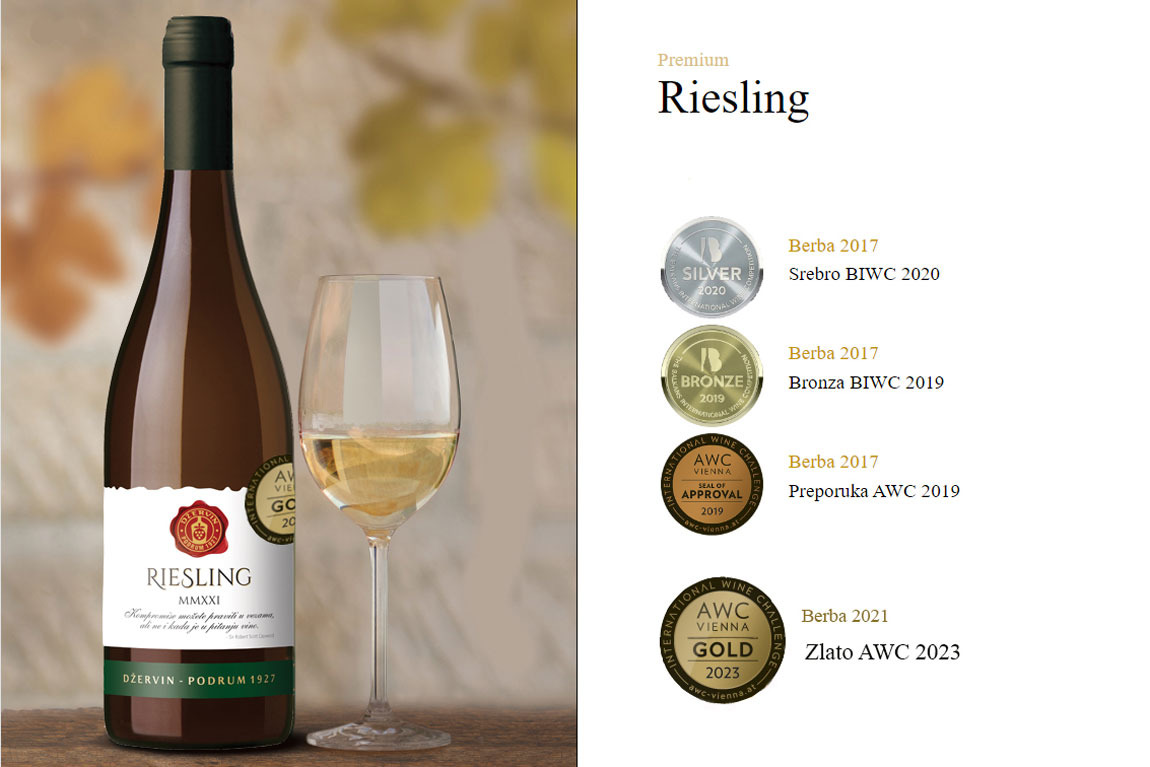
– Two years earlier the Sauvignon Blanc 2019 won platinum at the Serbian National Wine Assessment at the Radisson Collection hotel, and in 2022 it took gold at the Balkan BIWC competition. The Rose Pinot won too, the Riesling 2021 took gold at AWC Vienna last year, and the Schlossberg 2019 silver. We didn't make a big fuss about it. What confirms my philosophy is the fact that every wine we sent to Open Balkan won something. Now we can send Trifun to the Decanter World Wine Awards with a clear conscience.
What is Džervin today?
Right now it is 43 hectares of vineyards, with a plan to plant another 15 over the next three years. Most of it is Grašac, because when we finally privatised the company in 2013 there were about 10 hectares of what was then called Italian Riesling – a neglected vineyard lying on the ground. We came in planning to grub it up, but by chance, and luckily, I am an agronomist by profession, and although I had never worked with vines before, I recognised that the vines were relatively young.
And you stopped the grubbing-up?
That Grašac was planted literally just before the company went bankrupt; I don't know if a single harvest was ever brought in. I had been a wine lover for years, so the idea simply wouldn't let me go. I asked whether the vines, being young, could be brought back to life. We called the late Professor Žunić from the Faculty of Agriculture in Belgrade to take a look and give his opinion, and he said: "I did the project and planted that very vineyard!" He looked it over from end to end and said – yes, it can. But the vineyard had been laid out for a Džervin that made millions of litres, so Žunić drew up a study and we completed it in practice within two years, with new posts and wire. Today, on those 20 hectares, we have 10 hectares of Grašac and five each of Riesling and Pinot Noir.
And on the rest?
Later we planted another 20 hectares, bearing fruit from this year, mostly red varieties. Cabernet, Merlot, Blaufränkisch, a little Riesling and Sauvignon Blanc, plus Muscat Hamburg, which goes into our rosé.
"Our policy is that every bottle of wine must be equally good for me, for a guest, for the journalists who visit the winery. That same wine is what we send to competitions."
What goes into the Premium segment?
Take Riesling: we first bottled it in 2017, which was a very good year. Those wines won awards, and then came the 2019 and 2021 vintages. We bottle a wine only when we judge it good enough for the Premium category; if not, it goes into a blend and then into the litre segment – which is why that segment is always very good.
How much bottled wine do you have?
There are two quality levels of bottled wine. We don't make much Premium: five to six thousand bottles a year per label, of which we have several, around 20,000 bottles in total. The middle category, the blends, adds another 50,000 a year, and everything else is litre wine. Total annual production reaches 250,000 litres, and we plan to increase it.
"We try to give the wines a personal stamp. We make them from the heart, because I am not fond of the option: pay the most famous, most expensive oenologist and you'll have the best and most expensive wine."
Which grape is your favourite?
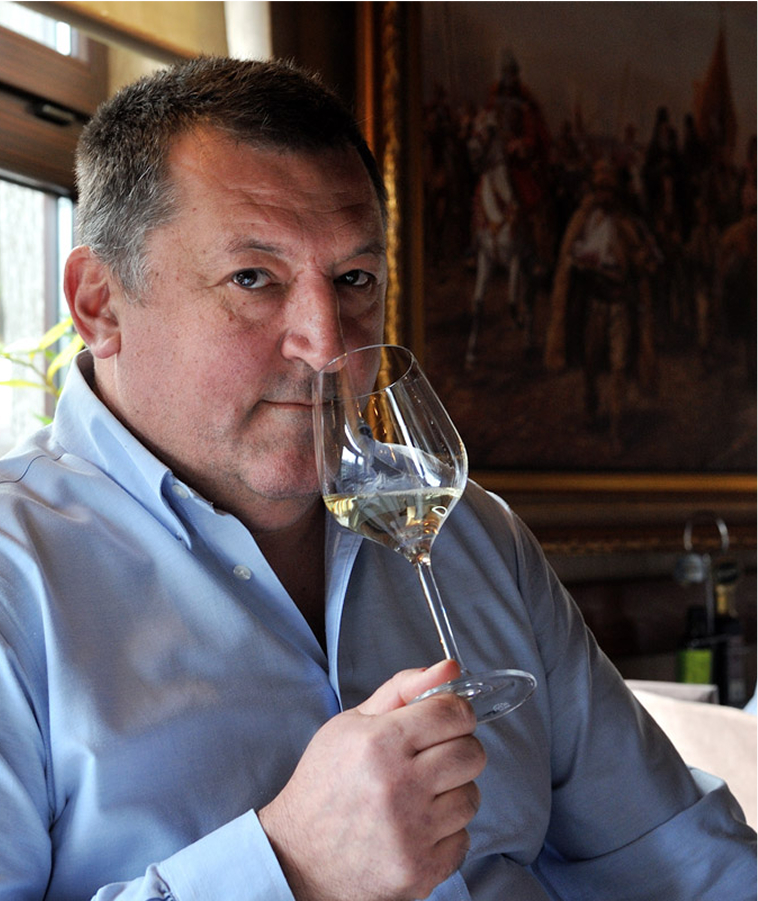
Sauvignon Blanc is definitely my favourite, which is why it is so good at Džervin. Among the reds, of course, the single-variety Cabernet, although we also make Schlossberg as a blend of 70% Merlot with Cabernet.
With platinum at the Open Balkan Trophy for the 2019 vintage, Cabernet will clearly be your guiding star from now on?
2019 was a top year for grapes. The vineyard was young, it was its first harvest, it didn't give much – only 4.5 to 5 tonnes from three hectares, but at 26 degrees of sugar. Phenomenal fruit, and we didn't have a single barrique. It hadn't even crossed our minds, because we had planted the Cabernet to strengthen the Schlossberg; but when we saw what we had, we said: no joking around. Thank God we have the space – let's put it to use quickly.
How did you solve the problem?
We were lucky that a barrel maker from Velika Drenova let us have 12 or 13 barriques of Serbian oak, in which we aged the Cabernet. The result at the OB Trophy – where even our middle line, at five euros on the shelf, won two silvers and a bronze – shows that the price-to-quality ratio is very good.
Who are your customers?
We make wine above all for the domestic market and for ordinary people. The person who drinks every day, for whom a 1,000-dinar bottle is too expensive, but who, because they like quality, won't even look at one for 250. To them we offer a wine for 400 or 500 dinars that is genuinely good. And one they can drink every day – which is why we put screw caps on, so they can save some for tomorrow.
What motivated you to invest in a winery?
To finally, once in my life, do a job I truly love.
After 10 years, has it proved a good investment?
We appeared on the market in 2016, and seriously only a year later. Growth was excellent, 30% a year, right up to 2020, when we planned for 35% growth and expected it to be Džervin's final breakthrough on the market. January and February proved the calculations right, and then Covid arrived and set us back literally two years. Then, just as everything was going well in 2022, the war in Ukraine broke out. Packaging, energy – everything went through the roof. By the time we had sorted out pricing and everything else, we had slipped off the market a little again, losing literally three years of projected growth. Finally, in 2023, things started to warm up and we caught up with the direction we had predicted in 2020 – that after five years a winery business can be made to pay. In any case, owning a winery is a marathon, a long-term race, something we leave to future generations and from which you personally won't get rich. The grandchildren might.
"Owning a winery is a marathon, a long-term race, something we leave to future generations and from which you personally won't get rich. The grandchildren might."
How best to explain to people that the quality of your wines today far exceeds Džervin's old reputation?
Give the market quality wines. I believe you can only attract a customer with packaging that is interesting from a marketing point of view – that's half the job done, which is why we are in the process of rebranding. If good packaging attracts them – and price does matter – and they decide to buy and find a quality product in the bottle, then you have won a consumer. We also want to present the Premium line as well as we can, where the many medals coming in will certainly be a positive boost, as will our presence at almost every wine event.
You probably know the wine scene in Novi Sad. Is there room for Džervin on the fiercely local Fruška Gora scene?
Novi Sad has always been a broad, open city for all kinds of novelties and good things. Fruška Gora's influence on sales is great, but wines from all over Serbia are drunk there; people like to try them. We are present on that wine scene. We are not in a great many restaurants, but people know us and we sell well. We are expanding our presence and sales year on year, though not aggressively; we work with people where there is a positive interaction. I have to admit, we are happier with our sales in Novi Sad than in Belgrade.
"We also want to present the Premium line as well as we can, where the many medals coming in will certainly be a positive boost."
Where can your wines be found – in retail chains?
Yes, we sell most through chains such as Mercator and Delhaize, we are in the HoReCa sector, and we are least represented in wine shops, which we certainly want to fix urgently. Even in Novi Sad we are not present as much as we would like. That is why I sincerely believe we will do something serious at Decanter this year, which will be a good recommendation for wine shop owners. It is very important, because people need to hear that, besides the other segments they like, we also have something extra. We have started now with the Cabernet and the Sauvignon Blanc; it doesn't happen quickly, but it is worth the effort.